# Mac OS Hotkeys & Shortcuts

This section is all about non-listed or non-obvious hotkeys for software. These keys lean Mac OS, but many work on Windows if you substitute Command for Alt.

In creative applications “shift” is generally used as a modifier key to increase the units of an action. In After Effects, for example, shift is a modifier x10 – so if you use the hotkey to advance one frame, and hold shift, it advances 10 frames.

<table border="1" id="bkmrk-symbols-can-be-found" style="border-collapse: collapse; width: 100%; border-width: 0px; height: 130.9px;"><colgroup><col style="width: 63.528%;"></col><col style="width: 36.472%;"></col></colgroup><tbody><tr style="height: 130.9px;"><td style="border-width: 0px; padding: 0px; height: 130.9px;">Symbols can be found in file→emoji and symbols work within most applications.

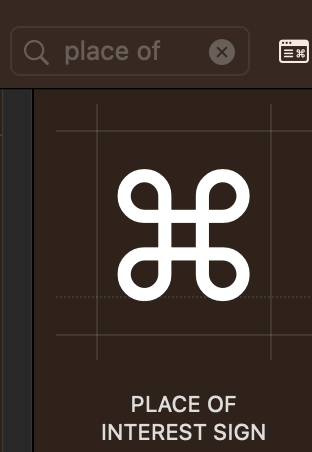
The command graphic is called “Place of Interest Sign” (and not “Command”) lol.

Point being, if you're looking to write out a bunch of hotkeys, you gotta type "Place of Interest Sign" in the character viewer.

</td><td class="align-left" style="vertical-align: middle; border-width: 0px; padding: 0px; height: 130.9px;">[![PlaceOfInterest.png](http://tech-almanac.org/uploads/images/gallery/2025-04/scaled-1680-/placeofinterest.png)](http://tech-almanac.org/uploads/images/gallery/2025-04/placeofinterest.png)

</td></tr></tbody></table>

### Mac OS System Wide

<table border="1" id="bkmrk-%E2%8C%98%2B%2C-this-triggers-pr" style="border-collapse: collapse; width: 100%;"><colgroup><col style="width: 25.1394%;"></col><col style="width: 74.8586%;"></col></colgroup><tbody><tr><td>⌘+,</td><td>This triggers preferences or settings in many applications</td></tr><tr><td>⌘+C / ⌘+V</td><td>Copy / Paste</td></tr><tr><td>⌘+Shift+V</td><td>Often used as “paste values” rather than paste items. </td></tr><tr><td>⌘+S</td><td>Save</td></tr><tr><td>⌘+Shift-S</td><td>Save As</td></tr><tr><td>⌘+A</td><td>Select All</td></tr><tr><td>⌘+I</td><td>Get Info</td></tr><tr><td>⌘+Option+I</td><td>Combined Info of all selected files (allows you to quickly tally up file sizes without manual entry!)</td></tr></tbody></table>

### Mac OS Finder &amp; System Preferences

<table border="1" id="bkmrk-cntrl%2B%E2%8C%98%2Bspacebar%C2%A0-wi" style="border-collapse: collapse; width: 100%;"><colgroup><col style="width: 25.1469%;"></col><col style="width: 74.8531%;"></col></colgroup><tbody><tr><td>Cntrl+⌘+Spacebar </td><td>Will open character viewer (on full keyboards, FN does this)  
</td></tr><tr><td>⌘+fn+F1</td><td>**This will mirror your displays.** This is very helpful when you have a dead display and need to access your files on an external monitor and it’s stuck on “extend.”   
</td></tr><tr><td>⌘+F1</td><td>Toggles mirroring on and off.   
</td></tr><tr><td>⌘+Shift-</td><td>Show hidden files (system wide, not just the active directory)  
</td></tr><tr><td>Opt+☼</td><td>(Brighten or dim keys, usually F1/F2) will take you to Display system preferences</td></tr><tr><td>Opt+(any audio key)</td><td>(Usually F10/F11/F12) will take you to Sound system preferences</td></tr><tr><td>Opt+Right Click+Click File</td><td>Gives you more contextual options, copy file path is a big one that I can’t believe I’m just learning in 2024. I’ve been dragging files into terminal to get the string for years.</td></tr></tbody></table>