Power Zone
Electricity, Power Ratings, Plugs Types, Voltage, etc
Dual Voltage, Warnings, Travel
We all know that you can have multiple projectors on the same circuit if you do your math correctly or if you have a higher amperage circuit, but for most situations, you either have a 15 or 20 amp circuit and it's usually not dedicated so be careful.
General Warnings
Never plug-in and power up any of these products on the same circuit simultaneously : AC, Hairdryer, Vacuum, Toaster, or Projector
Different Voltage and Dual Voltage
For most consumer products, there are two main voltages – 208 Volts and 110 Volts. Most of the world operates on 208 Volts and in the United States, Canada, Mexico and in some of South America, they operate at 110 Volts. Certain products are rated for one or the other. Some work on both. Some require a different power supply brick to work on a different voltage. Some work with limited functionality on different voltages.
Don’t ever plug-in 208v in 110v and vice versa unless the product is rated 100-240v (dual voltage), or if you have a step-up/down converter.
Some products just need a different power supply or brick if the one you have doesn’t support the voltage you need. This is better than using a step/up down. Things like: switches / wireless routers can often be adapted to other voltages using a different PSU.
International Power
As of 2023, changes in NRTL (Nationally Recognized Testing Laboratory) certification requirements have changed for dual-voltage products. Companies whose products used to be rated 100-240v, are now rated for 125v. Anker, whose power supplies I’ve been using all over the world for over a decade, are no longer rated to 100-240v in terms of their certification, but in practice are rated as 100-240v. If the voltage you need isn’t printed on a product, you might be lucky and find that it does support dual-voltage. Always contact the manufacturer if you need to find this out and spec isn’t clear. I called Anker. That’s how I know!
When traveling internationally, you can use a 220v rated NEMA 5-15 power strip with the relevant adapter on the input end. Anything you plug in from there will work fine as long as it’s rated for 110-220v. However: you may get flagged if you try to do this in the back of a venue. You can either use a fused adapter per device (laptop adapter mode) or you can get an IEC based PDU. As long as all devices are rated 110-220v and have IECs. You can use an IEC male to IEC female into a device PSU, and then the PDU itself has its own IEC that you can swap depending on the outlets for the country you’re in.
Example IEC PDU: Tripp Lite PDU12IEC

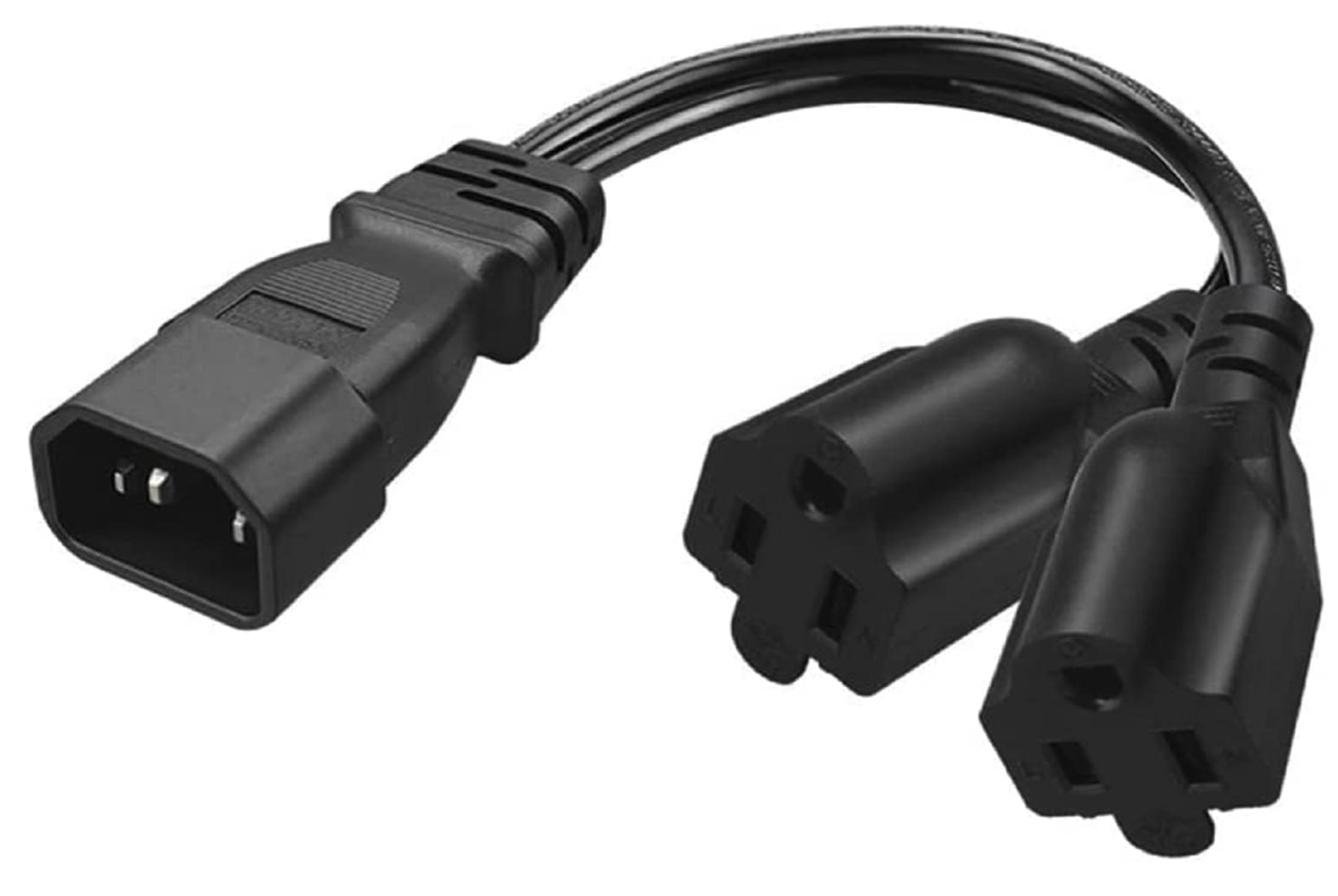
Example IEC 5-15 Breakout That You Shouldn’t Use But Is Totally Fine If You Do Your Math And The Products Are Dual-Voltage: Toptekits C14 to 2XNEMA5-15R
Power Definitions and Formulas
Power Definitions
| Breaker | Those little things in a breaker box that can get flipped if you’re looking to have a good time. In the USA, circuits are commonly 10, 15, or 20 amps. Things like washer / dryers are often on a 30A circuit, which could be represented by one or two breakers! |
| Circuit | A circuit is the name for the group of outlets that are tied to the same breaker. A circuit is most often a single breaker, but not always. You can have many outlets on the same circuit, but you can only consume what the breaker is rated to minus ~20%. |
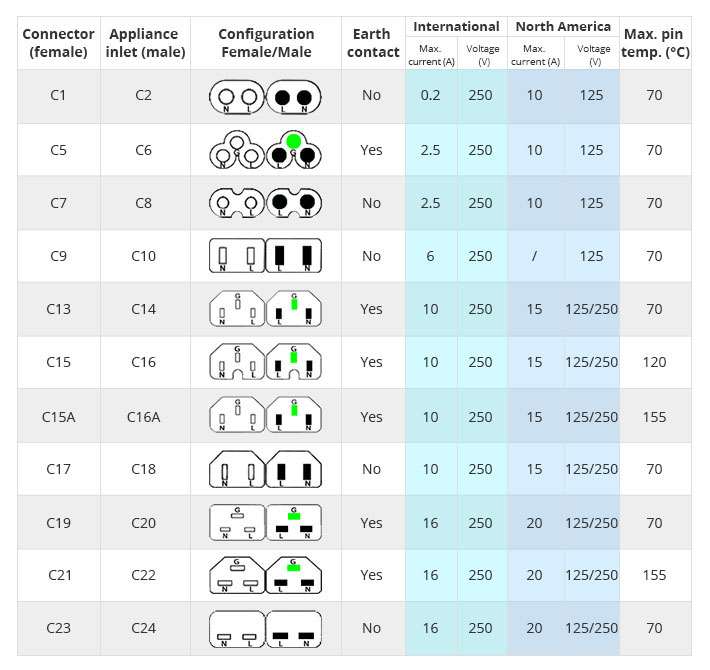
| IEC | This is the cable that powers a device. This is not a PSU, but it is often the cable that plugs into the PSU. There are many types of IECs out there, but the most common are a two prong that look like they belong to a 90s boom box, and three prong that you see everywhere like computers, monitors, etc. |
| In-Rush Power | Most devices pull more power than what their normal draw is during their power up. This is called In-Rush. You might be drawing way less power during regular operation. To solve any gremlins caused by this, you just need to chase the power-on order of your devices so that their offset by a few seconds. This limits simultaneous rush power and you’ll be good! |
Power Formulas
Watts = Amps x Volts
Amps = Watts / Volts
Volts = Watts / Amps
Types of Plugs, Ends, IECs
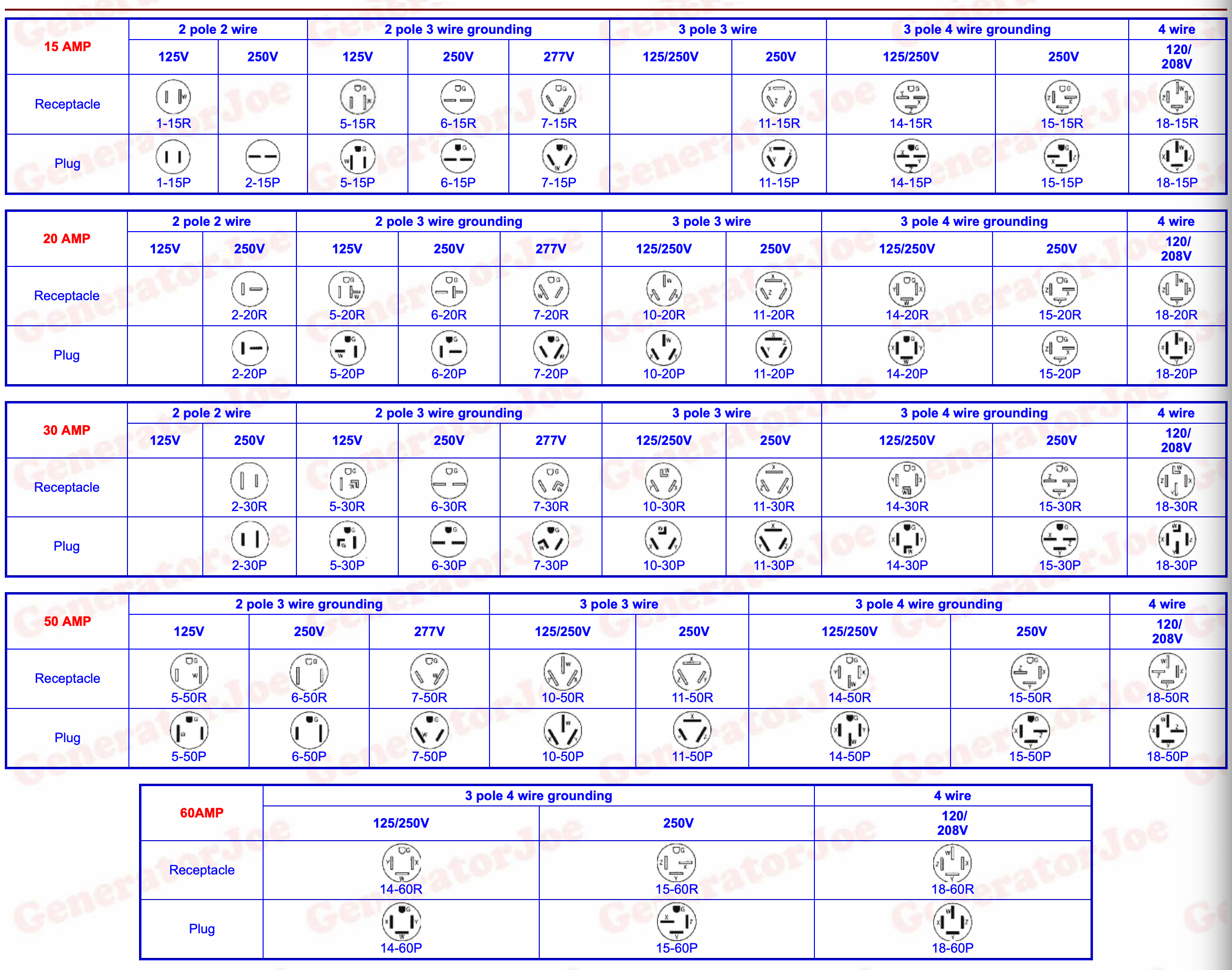
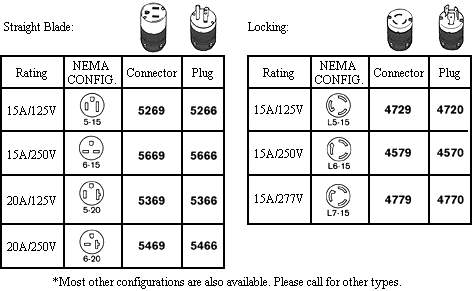
The three prong plug you see in most places in the US, Canada, Mexico and some of Central/South America is a NEMA 5-15
Projector 208v plugs are often NEMA 6-15P and C19s on the IEC end.
Types of Plugs
From Genratorjoe.net
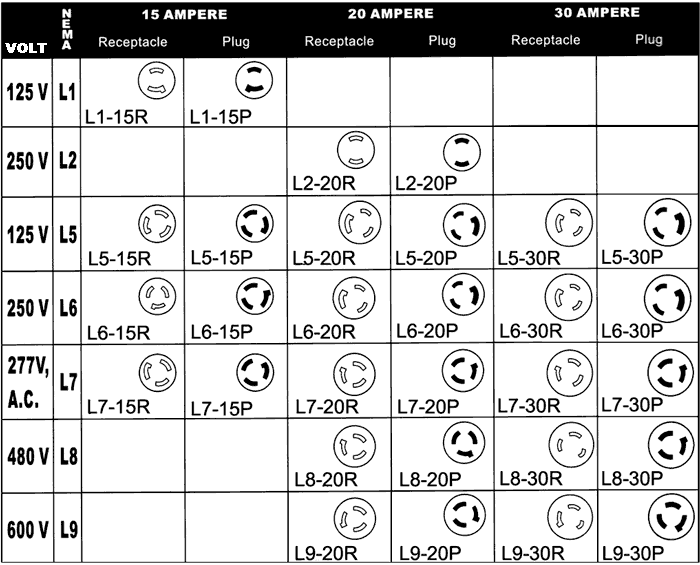
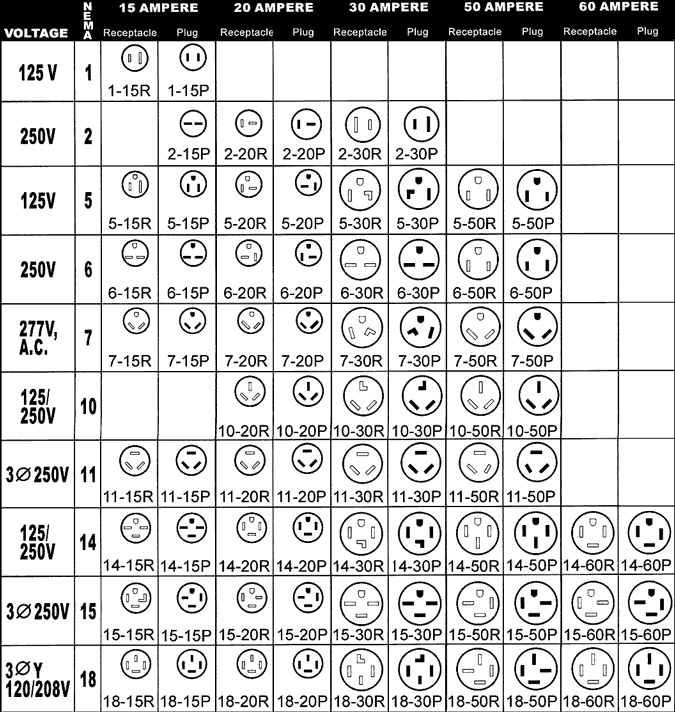
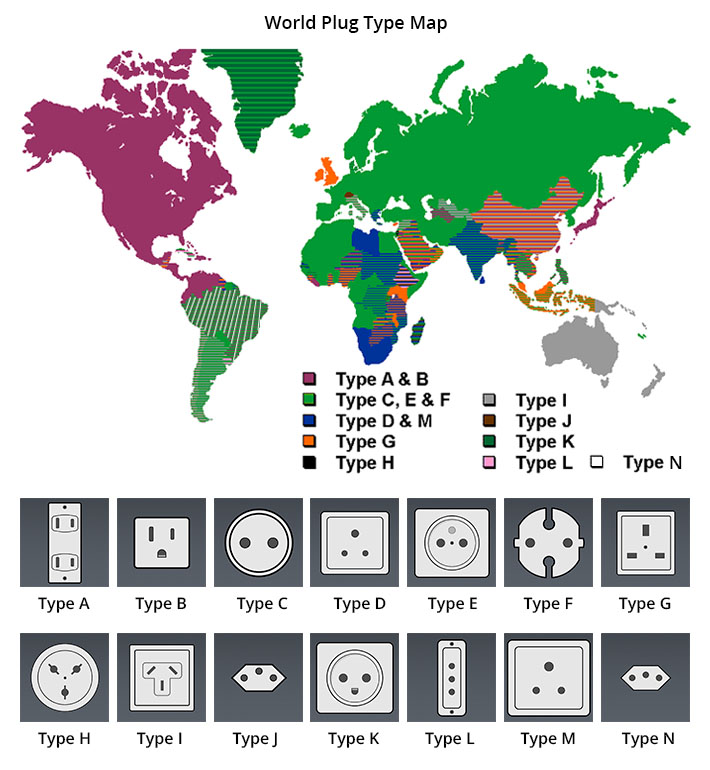
World Plug Map
What adapters do I need when I travel?
From fs.com
Types of IECs
From fs.com